An Incredible Substance – Raw Milk

Raw milk is a much more valuable substance than what most people realize. Everything that we have fed it to has become more healthy. Our family consumes about 7 to 10 gallons of the stuff a week. The yogurt that we make with it is usually mild and not very tart. We noticed a difference in our children’s health one winter when our cow was not producing milk. The children had more sickness, colds, etc. than they had other years when our cows were producing milk.

We feed the baby chicks raw milk and it has made a significant difference in their health. The chickens grow much better and we have very few die. The milk also seems to make the chicken meat more tender. We have found that calves and lambs that we bottle feed do much better on raw milk than on milk replacer. Raw milk is one of the best protein sources for laying hens. We don’t give the hens milk very often because we do not have enough extra milk, but we have used it when a flock was not doing as well as it should, and they improved with the raw milk added to their feed.

Last summer we discovered another valuable use for raw milk. In our garden, there were a number of different types of vegetables that were low brix. We tried different types of foliar sprays that should have raised the brix. Instead, they lowered the brix. The Brix Talk discussion board did not have any solutions. I couldn’t find a solution anywhere. So I asked God to show me what to do. He brought to my mind that in the Bible the Land of Canaan (what is now Israel) was called a land flowing with milk and honey. I always assumed it meant that it was a very productive area that produced a lot of milk and honey. This time the thought that came to me was, "What if milk and honey put on the plants would make them more productive?" I did a test and sprayed some milk and honey on various plants in the garden. About an hour later I tested the brix. To my surprise and joy the brix had risen 3 brix on most of the plants. The brix of clover raised from 8 brix to 13 brix. We have used the milk and honey spray on our garden this year with excellent results.

When the brix (sugar and mineral content) of the leaf of a plant is above 12 brix, insects will leave the plant alone. The high sugar content of the plant causes alcohol to be produced in an insect when it eats the high brix plant. It gives the bug diarrhea which results in dehydration and death. We had heard that when the vegetables in a garden are high brix, the insects will leave the vegetables alone and start attacking the weeds. We found it to be true. Insects attack plants that are low quality. In poor soil the weeds are higher brix and the vegetables are low brix. When the plants have the right amount of calcium and phosphates the opposite occurs. The weeds are low brix and are attacked by the bugs and the vegetables are high brix and the bugs leave them alone. Conventional agriculture mindset is to spray anti-life chemicals on the plant to kill the bugs, and then feed the poor nutritional quality vegetables to us. The following pictures show some weeds that the insects were eating.


The bugs attacked the weeds in the corn patch. The brix of the corn leaves was 15 brix.


Japanese beetles were eating on the weed in the center of this picture which was in the potatoes. We did not have any problem with potato beetles eating the potato plants. The brix of the potato leaves was about 12 brix.

We had a problem with the Japanese beetles eating our grapevines. After we sprayed the grapevines twice with milk and honey about a week apart, the beetles left. The milk and honey mix that we use is:
3 1/2 gallons of water
1/2 gallon of raw skim milk
1 cup of honey

I put the milk and honey spray in a pump up bug sprayer and sprayed the plants. It might be possible to get the same results without using the honey. I have not experimented with that yet.

Recently I read an article in a farming magazine, The Stockman Grass Farmer, about a dairy farm in Nebraska that had raw skim milk that was a waste product from making butter and cheese. To get rid of the milk, the farmer applied it to his pastures. He found that where he applied milk it made a significant improvement. It significantly increased the microbes in the soil and the growth of the grass. Further test plots showed that the raw milk applied once, at the rate of three gallons per acre, increased the yield of the hay by 1200 pounds per acre! Their conclusion was that raw milk could be worth two to three more times more money as fertilizer!


Several weeks ago we bought another cow – a Guernsey. Why a Guernsey?

One reason is that my grandfather had a purebred Guernsey dairy herd and sold "Golden Guernsey" raw milk. My father talked about how good the golden Guernsey milk was. We found that we like it better than our Jersey milk. But the real reason that we wanted a Guernsey is that some recent research has found that there are two different types of milk protein – A1 beta casein milk protein, and A2 beta casein milk protein. The A1 beta casein is what most people who have casein intolerance are allergic to. Goat and sheep milk are A2 beta casein. There is a "controversial" claim, based on 16 years research, that the A1 beta casein which is drunk by most people in the US could be a cause of diabetes, heart disease, autism, and schizophrenia in people with immune deficiencies. It is also claimed that the A2 beta casein does not cause these problems. Research has showed that 96% of the Guernsey breed of cows have the A2 beta casein, while the Holstein (black and white) breed from which most of the milk in the US is produced, has the A1 milk protein. Obviously this is very damaging information for the dairy industry and there has been considerable attempt to suppress the information about A2 milk.

For more information read
http://www.naturalnews.com/026684_cows_diabetes_protein.html or the
book Devil in the Milk by Keith Woodford.

Another use for milk is to help a person refuse what is bad and choose what is good. In the Bible, Isaiah 7:15 says that Jesus would eat butter and honey so that He would know to refuse the evil, and choose the good. That is one of the benefits of adequate calcium in the diet. I have heard that the proper type of calcium, according to a person’s body’s need, can help an alcoholic give up alcohol, or a smoker give up cigarettes. The proper calciums can also help children calm down and be well behaved without the use of mood altering drugs.

Raw milk can also be used to cure a number of chronic diseases. The Weston A Price Foundation has a very interesting article about raw milk being used to cure a number of different diseases. http://www.realmilk.com/milkcure.html Recently we purchased the book Milk Diet as a Remedy for Chronic Disease, by Dr. Charles Sanford Porter. It is a reprint of a book that was originally printed in 1905. This book goes into great detail about how to conduct a milk fast to cure sickness.

Raw milk can also be an important survival food. It is a food that can be produced fresh every day year round and consumed without further cooking or processing. This idea came from the Bible, Isaiah 7:21-22: "And it shall come to pass in that day, that a man shall nourish a young cow, and two sheep; And it shall come to pass, for the abundance of milk that they shall give he shall eat butter: for butter and honey shall every one eat that is left in the land."

Raw milk is a valuable substance. It is unfortunate that it is illegal to buy or sell raw milk here in Maryland. Perhaps some day…

Update, August 9th:

One thing I failed to mention in last month’s article is that the milk and honey foliar spray did not work for us on green beans. It actually decreased the brix. The foliar spray that we use on our beans is:
4 gallons of water
12 tbsp molasses – we use feed grade
16 oz. Cola soda – a source of phosphoric acid
4 tsp hydrated lime
10 tbsp liquid fish
4tbsp seaweed powder
8 oz. apple cider vinegar
1 tsp sea salt

We also alternate the above foliar spray with milk and honey on our sweet corn. Our sweet corn was 26 brix this year. 24 brix or higher is in the excellent range.

The Most Important Plant Food – In Your Face and You Can’t See It!

The most important and needed plant food is everywhere. You can’t see it, but you can feel it. You can’t control it or buy it, but it is available for free everywhere. It is as light as the wind, but it makes trees weigh many tons. After I found out what the most needed plant food was, it has totally changed the way I look at plants and think about feeding them.

Over and over I ask God to teach me how to farm, and He has been teaching me some things that I find very exciting. I do not want to take the credit for what I am learning and sharing with you. I did not grow up on a farm, nor am I smart enough to discover the things I am learning on my own. God is the one who is showing me how to put together the different "pieces of the puzzle" that others have found so that I can see the bigger picture. The more I learn, the more I realize that farming is one of the most unexplored frontiers when it comes to understanding how to raise plants and animals so that they have the highest nutrient value that produces the greatest health and longevity for us as people.

At least 80% of the nutrients that a plant needs to grow comes from the air. Air is the most important and needed plant food. I first learned about this concept from Carey Reams who discovered it a number of years ago from his research. Recently I was reading in the 2005 edition of Biological Science by Scott Freeman. In the early 1600’s Jean-Baptiste van Helmont planted a five pound willow sapling in 200 pounds of soil in a container. He predicted that the soil mass would decrease by the same amount that the plant mass increased. After 5 years, the tree weighed 169 lbs, 3oz. The soil weighed 199lbs, 14oz. He concluded that since the soil had not significantly decreased, the additional 164lbs 3oz of tree had come from the water. Later research has found that conclusion to be incorrect and that most of the mass of the tree came from the air, most of it being carbon dioxide.

This past week Cathy and I celebrated our 23rd wedding anniversary. We went over to beautiful West Virginia and drove through parts of the Monongahela National Forest and surrounding areas. One of the places that I wanted to show Cathy was the Dolly Sods Wilderness area. I had visited it 30 years ago as a teenager when our family vacationed in the area. Dolly Sods is a unique area. It is a high plateau with a cool climate. The tundra-like landscape is described as similar to parts of Alaska and Canada. It receives as much as 290 inches of snow each winter. 30 years ago, most of the trees were short and scrawny and appeared to be struggling for survival in the harsh climate. Many of the trees had branches only on the east side because of the strong winds from the west. Large rocks were visible everywhere.

Last week, I was surprised at the change that had occurred in 30 years’ time. Only a few of the trees had branches only on the east side. In most of Dolly Sods, the vegetation was lush and dense. The land is healing itself. As we thought about it, we realized that the healing to the soil was coming from the air. A bit of history of Dolly Sods will shed more light on the nutrients coming from the air.

The history is drawn from the wikipedia.org article on Dolly Sods.

In 1852, Dolly Sods was described as a tract of land entirely uninhabited, and so savage and inaccessible that it had rarely been penetrated even by the most adventurous. Settlers on its borders spoke of it with a sort of fear as they described it filled with bears, panthers, and impassable mountain laurel thickets that had caused hunters who had ventured too far to perish. The area was covered mostly by a dense Red Spruce and Hemlock forest. Some of the trees measured 12 feet in diameter. Years of accumulated needles from these trees created a thick soil humus seven to nine feet deep!! (Note where the deep top soil had come from, not the ground or fertilizer applied to the soil, but from the air! The nutrients that the trees took in from the air grew the spruce needles and when the needles dropped to the ground they increased the depth of the topsoil.)

In the late 1800’s, logging moved into Dolly Sods, and the huge trees were cut down. The thick soil humus dried out and sparks from railroad locomotives, logger’s fires, etc. started fires which burned the humus in the soil. Fires repeatedly swept through the area in the 1910’s until the deep seven to nine foot deep humus topsoil had burned down to rock leaving a thin layer of soil.

As I viewed Dolly Sods this past week it was another object lesson to me that plants do take in nutrients from the air and in the process can enrich the soil so that the plants can have the deep topsoil that they need for the nutrients that they get from the soil. It was also an object lesson to me that when we don’t understand how plants work, we can be very destructive like the loggers were and like chemical agriculture is today. If the loggers had understood how plants work, trees could have been harvested from Dolly Sods and the area managed in such a way that would have produced incredible amounts of lumber indefinitely. Unfortunately, ignorance is not bliss. It is very destructive.


This is a view of the north end of Dolly Sods, which is still a lot the same as it was 30 years ago. Note how short the trees are and how they have branches mostly on one side.


This is what most of Dolly Sods looks like today. The trees are getting tall and creating enough wind break that branches grow on all sides of the tree.


The mountain laurel is coming back. It was just starting to bloom last week. It is reported that there are spectacular displays of mountain laurel in bloom in late June. Note how lush it is, and the dense growth of ferns in the foreground.

How we are applying this knowledge here on the farm
In the American chestnut orchard, we have been letting the grass grow a foot or more tall and then mowing it short. The result has been a significant increase in the growth of the grass compared to the pasture outside the chestnut orchard fence. In addition, the chestnut trees have been having significant growth last year and this year. The chestnut orchard has been my classroom where I have been learning some important lessons on how to capture the energy in the air with the grass and put it into the soil to improve the health of the plants so that they can pull more nourishment out of the air.


The American/Chinese cross chestnut trees this spring have showed significant new growth. The light green is the new growth. These three year old trees, planted as nuts in the spring of 2007, added at least two to three feet of growth on each side and in height in the last two months.


We purchased a tractor and a sickle bar mower this spring to mow the pastures so we can build/deepen the topsoil with the mowed grass. Carey Reams found that grass should mowed with a sickle bar mower and not be mowed with a rotary mower if you want to keep the most nutrients from the grass. A rotary mower or bush hog chops up the grass too much, and many of the nutrients in the grass evaporate into the air again and are lost. We mowed a section of pasture last year with a sickle bar mower and left it laying on the ground. The grass grew back with much more growth than where we mowed with a rotary mower.

We have found, too, that mowing the chicken pastures on a regular basis has significantly increased the brix reading of the grass. The higher brix grass has more nutrients, protein, and omega-3’s increasing the nutrient density of our eggs, and chicken and lamb meat.

There is much more about plants getting their nutrients from the air that remains to be discovered and applied. If any of you have a piece of the puzzle, please share it with us. We would be glad to hear about it.

Maryland is Becoming More Small Farm Friendly!

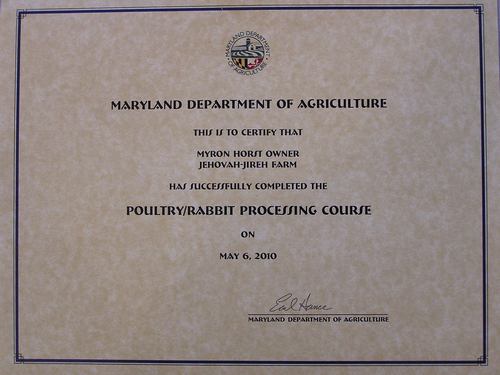
It has been discouraging the past number of years with all the reports of how the government is making things harder for small farmers and is supporting the big factory farms. We have some good news. Maryland Department of Agriculture is developing a certification and inspection program that will enable small farms to process chickens and rabbits and sell them to stores, restaurants and at farmers markets. Currently farmers are only allowed to sell chickens and turkeys to the end user at the farm under the Federal exemption. Several of us attended the processing training course on May 6. I was impressed with how they are going out of their way to make things as easy as possible for us to be certified. They are looking for ways to keep our costs as low as possible. The requirements are very reasonable and are basically what we have been doing already.

The Maryland Department of Agriculture is recognizing the demand for locally produced food and is helping you to be able to get it. A new law was also recently passed that reduces the permits and costs for farmers selling at farmers markets.

The next question is, when will we start selling chickens in the stores? We do not know. We are not sure if that is a direction that we want to go or not. We are currently selling eggs in eight stores in Maryland. To sell chickens even to one store would mean significantly increasing our production as well as processing one day a week rather than just once a month. Processing chickens is the least fun job and it is hard work. We are not sure at this point if we want to take on the additional work that would be required to sell to the stores.

The Importance of Local Food – Lessons from Haiti

Last month, on March 20, the Washington Post ran an interesting article titled "With Cheap Food Imports, Haiti Can’t Feed Itself". After reading the article, I realized that our national agricultural situation in the United States is similar in several ways to Haiti – we import about half of the food that we eat, and the cheap food imports have caused many farmers to go out of business. As a nation, we can no longer feed ourselves.

Thirty years ago, Haiti imported only 19 percent of its food and produced enough rice to export. It was able to do that in part as a result of protective tariffs on rice of 50 percent which were set by the father-son dictators Francois and Jean-Claude Duvalier.

When their reign ended, the United States and Europe pushed Haiti to tear those market barriers down in the interest of "free trade". In 1994, President Jean-Bertrand Aristide, who was freshly reinstalled to power by Bill Clinton, cut the rice tariff to 3 percent.

The Haitian farmers, unable to compete with the billions of dollars in subsidies paid by the U.S. to its growers, abandoned their farms and moved to the cities. Today, Haiti depends on other countries for 51% of the food that it needs and 80% of the rice. For the Haitians, their dependence on imported food has been a disaster.

Last month, after being in Haiti, Bill Clinton publicly apologized for championing policies that destroyed Haiti’s rice production. On March 10, Clinton told the Senate Foreign Relations Committee, "It may have been good for some of my farmers in Arkansas, but it has not worked. It was a mistake. I had to live everyday with the consequences of the loss of capacity to produce a rice crop in Haiti to feed those people because of what I did; nobody else." Clinton is to be commended for seeing the consequences of a failed policy, apologizing for it, and now working to rebuild the agriculture in Haiti.

Here in the United States, the same "free trade" policies have destroyed our ability to feed ourselves. Like Haiti, we import close to half of all our food. When I was young, America was called the bread basket of the world. Today, cheap imports from China and other countries have forced many American farmers out of business. Many of the farms that remain are large farms that are heavily subsidized by the US government.

The difference between the food situation in Haiti and here in the United States is that we have money to feed ourselves and we have not had a national disaster. A war, or a breakdown in relations with China could change our food situation rather quickly.

Fortunately, millions of Americans in recent years have realized the importance of supporting small local farms and eating locally produced food. The demand has grown considerably for locally produced food. However, it is still difficult for small local farms to compete with cheap imported food and food produced by big corporations. As a result, there are few new farms starting up. Currently in the U.S. there are millions of unemployed people. Our high unemployment problem could be ended if we brought our food production and manufacturing back home. Support your local farmers. They need you and you need them. Let’s learn an important lesson from Haiti – it is important that we, as a nation, are able to feed ourselves.

A link to the AP article: “With Cheap Food Imports, Haiti Can’t Feed Itself” http://www.huffingtonpost.com/2010/03/20/with-cheap-food-imports-h_n_507228.html

A related article is one I wrote in our newsletter two years ago " Creative Destruction Related to Farms". In it are some excerpts from the Federal Reserve describing how they used financial engineering to reduce the number of farms and factories in an attempt to create a higher standard of living for Americans. https://www.jehovahjirehfarm.com/articles/2008/05/12/creative-destruction-related-to-farms/

Monsanto – Too Big to Fall?

Here in the Washington DC area you often hear Monsanto running ads on the radio touting how they are helping farmers feed the world and how they are supporting sustainable agriculture. However, Monsanto is anything but a supporter of sustainable agriculture. They are a giant agricultural chemical and genetically modified (GMO) seed corporation that has done much damage to sustainable agriculture. Many people have lamented how Monsanto has been able to "legally" run rough shod over farmers in developing a monopoly in the agricultural world.

Last month, a little reported, but very significant event happened. France’s Supreme Court ruled against Monsanto, saying that the agrochemical giant had not told the truth about its best selling weed-killer, Roundup. Monsanto had falsely advertised Roundup as being "biodegradeable" and claimed that it "left the soil clean".  Roundup is not biodegradable and it does contaminate the soil.

For years we have been told that when Roundup is sprayed it kills plants, but when the chemical comes in contact with the soil it is neutralized. It has been said so often that many believe it to be true. France’s Supreme Court’s ruling shows proof that Roundup is not neutralized in the soil. The use of Roundup is one of the leading reasons why Monsanto has developed genetically modified seeds. The plants grown from their genetically modified seeds can be sprayed with Roundup and will not die. That enables farmer to spray their fields with Roundup and kill the weeds after the corn or soybeans have come up and not harm the corn or soybeans.

Keep watching. Someday – maybe in the distant future – but someday, Monsanto and their Roundup will likely disappear, never to be seen again.  "I have seen the wicked in great power, and spreading himself like a green bay tree.  Yet he passed away, and, lo, he was not: yea, I sought him, but he could not be found." (Psalm 37:35-36)

Monsanto’s philosophy is built upon the evolutionary mindset that there is no God and that genetic selection (including genetically modified organisms—GMO’s) is THE answer to improving food production and feeding the world. What is being missed is that while genetic improvement has increased food production, the nutrient density of the food has decreased along with human and animal health. More food has to be consumed to supply the needed nutrients and as a result, obesity is increasing among children. The majority of people and animals today are either on pharmaceutical drugs or natural supplements to try to have some semblance of health. This is a testimony that Monsanto’s method of genetic selection is not THE answer.

God created the soil full of minerals in the Garden of Eden. The soil has been declining ever since. It has been documented that in the last 60 years that the mineral density of the soils has significantly decreased. We need to first rebuild the mineral and organic density of our soil. Then we can select for genetic superiority. The seeds that have been genetically selected by Monsanto to grow in mineral depleted soils do not have the proper genetic expression to grow in nutrient rich soils and produce nutrient dense foods. Many organic farmers and gardeners have discovered this and that is why there is a growing interest in heirloom seeds. The heirloom seeds in improved soils produce higher protein food and nutrient density. Along with the nutrient density is a significantly improved flavor. Our mouths tell us what food is best for our bodies by how good the food tastes.  When a tomato looks like a tomato but acts and tastes more like a tennis ball, you can be sure that that tomato was genetically selected for some other quality than nutrient dense food. Listen to your mouth and eat what is good! If it has a poor taste quality it is poor quality food. That is true of meats and eggs as well.

Links to articles on Monsanto
http://news.bbc.co.uk/2/hi/8308903.stm
http://www.midnorthmonitor.com/ArticleDisplay.aspx?e=2160916  – An article showing how the "inactive" ingredients, the trade secret ingredients, that make Roundup more potent have been found to cause human liver cells to die.
http://www.rodaleinstitute.org/20080627/n1

The American Chestnut Orchard

As many of you know, the American Chestnut Foundation has an American chestnut breeding orchard located here on our farm. Recently a new sign was put up so that you can see where the orchard is located. The orchard is located on the right side of the lane, up the hill behind where the sign is located. The American Chestnut Foundation is working to develop a blight resistant American chestnut tree by cross breeding the American chestnut with the blight resistant Chinese chestnut. The cross bred chestnut trees are then back crossed with an American chestnut a number of times until a blight resistant chestnut tree is obtained that is 15/16 American chestnut. Currently, there are about 500 trees in our orchard. The oldest trees are four years old and the youngest ones were planted this spring.

The American chestnut was at one point the most important tree in the forests from Maine to Georgia. The chestnuts provided abundant food for many species of wildlife. The wood is beautiful and is great for cabinet making and furniture. In addition, the wood is excellent for outdoor projects as well. It has the rot resistance of redwood, but it is much harder and more wear resistant. In 1904 an imported fungus caused a blight which started killing the American chestnut trees. By 1950, approximately four billion trees on some nine million acres of eastern forests had been destroyed by the blight. Only a very few American chestnut trees remain today. When the American chestnut trees died out, a lot of wildlife went with them because a lack of food. The oak tree replaced the chestnut in many areas. However, the acorn does not compare in food value to the chestnut.

Chestnut orchard sign
Chestnut orchard
This is the entrance to the chestnut orchard. Note the deer fence to keep out the deer.

When I do volunteer work, I often feel like I receive a greater blessing than the ones that I help. This has been true in our work in caring for the chestnut orchard the last three years. When we moved here, the chestnut orchard was the worst piece of ground on our farm. The Department of Natural Resources had sprayed RoundUp and killed all the vegetation before they planted the chestnut trees. As a result, instead of grass, it was the most awful plot of thistles and other weeds! The trees grew poorly. For the next two years, I would let the thistles grow until they started making a flower bud, and then I would mow the orchard. I know that some of the people from the American Chestnut Foundation thought that I didn’t mow often enough and that my plan for getting rid of the thistles wouldn’t work.

This year I received the blessing from my labor. I discovered that in taking care of the chestnut orchard I had learned an important lesson on how to take a poor plot of ground and turn it into a highly productive soil. In addition the thistles are gone! The thistle plant is at its weakest point when it is starting to produce a flower. Its energy is being put into making seed rather than into growth. By repeatedly cutting it at that stage it is weakened and eventually killed. The chestnut orchard is now the best plot of ground on our farm. It was in the chestnut orchard that we discovered how to increase the brix (sugar and mineral content) of the pasture. This summer the brix of the clover in the orchard was as high as 17%, up from only 7% last year. We are using what we learned in the chestnut orchard to improve the soil on the rest of the farm.

So how did we improve the soil in the chestnut orchard? We did it by letting the grass grow tall and then mowing it short. The roots on grass go as far down in the soil as the grass is in height above the soil. If the grass is four inches tall, then the roots are about four inches deep. If the grass is a foot tall, then the roots go about a foot deep into the soil. When the grass is cut, the roots die back to the same amount that is left above ground. By waiting until the grass was a foot or more tall before we mowed it, it meant that we were adding a lot of organic matter a foot or more deep into the soil in addition to the grass clippings that were added on top of the soil. In other words, we are creating topsoil a foot or more deep. Not only is organic matter added to the soil, but also carbon is being sequestered in the soil as the roots die back. The grass takes the carbon out of the air in the form of carbon dioxide and puts some of it in the roots.

The results in the chestnut orchard this summer were amazing to me. I noticed significant growth in the trees throughout the summer. Last year the tallest trees that were at the end of their second growing season were about 42 inches tall. Last year the American chestnut foundation said that our orchard was one of the best growing orchards in Maryland. This year, with a similar amount of rainfall, the tallest trees at the end of their second growing season were seven to seven and a half feet tall! This was accomplished without any fertilizer.

So why doesn’t this principle of soil building work on your lawn? It is because a lawn is not left to grow a foot or more tall over and over through out the summer. If a lawn is cut when it is six inches tall, it is only adding organic matter into the top six inches of soil. The deeper the top soil, the better the growth of the plants. That is one reason why raised beds tend to be more productive. They add topsoil on top of the topsoil in the soil which increases the total number of inches of topsoil for the plant to grow in.

Two year old tree
This two year old chestnut tree is 7 1/2 feet tall. The 2×4 is 8 feet long.

Tree planted this spring
This is one of the chestnut trees that was planted as a seed this spring.
You can see Sugarloaf Mountain in the background.

Producing High Brix Food

A number of people have requested information on how to produce high brix food and how to increase the brix of the pastures.

Producing high brix food is not achieved overnight. It takes three to eight years to get the nutrients balanced in the soil so that high brix food can be produced. When you first get your refractometer and start testing your vegetables it is discouraging discovering how poor they are. However, it becomes exciting as you see the improvements in the brix reading, taste how much better high brix food is, and you know you can’t buy this quality of food in the stores.

The best way to know what minerals should be added to your soil is to do a soil test. It needs to be a weak acid LaMotte soil test such as is done by International Ag labs, not the usual strong acid soil tests performed by most labs.

The first year, in the fall of the year, plow the soil and apply soft rock phosphate at the rate of 100 pounds per thousand square feet or 10 pounds per 100 square feet. After applying the soft rock phosphate, apply high calcium lime at the same rate. Do not use dolomite or limestone with more than 5% magnesium. Magnesium releases nitrogen into the air and messes up the soil balance. We get lime from Frederick Farmers Coop in Frederick. It is called Thomasville lime (Old Castle) for $3.05 for 50lbs. Soft rock phosphate is available from Lancaster Ag for $11 for a 50lb bag. They will ship UPS. Lancaster Ag also has garden blends to help gardeners produce high brix food.

Producing nutrient dense, high brix food is more involved than just putting down soft rock phosphate and limestone.

There are also foliar sprays that you can apply to increase the brix. Our tomatoes, potatoes, squash, and cucumbers were low brix and I could not find a foliar spray that raised the brix. I remembered that in the Bible it referred to the land of Canaan as a land flowing with milk and honey.  I tried two cups of raw milk and a little honey per gallon of water. It raised the brix of the leaves of the plants from 7 brix to 10 brix. It raised the brix of the clover in the pasture about 5 brix.

A foliar spray that we used on the green beans and the sweet corn that raised the brix and produced 28 brix sweet corn was:
Per Gallon
6tbsp     molasses – we used feed grade
8oz.       cola soda – a source of phosphoric acid
1tsp       Hydrated lime
3tbsp     liquid fish
1tbsp     seaweed powder
14tbsp  apple cider vinegar

If you want more information, I encourage you to check out the websites listed below.  I also recommend reading the book Nourishment Home Grown by Dr. A.F. Beddoe. Refractometers that test the brix reading are available inexpensively on eBay. Get one that reads in the 0 to 32% range.

Weston A Price Foundation – High Brix farming and gardening
http://www.westonaprice.org/The-Quest-for-Nutrient-Dense-Food-High-Brix-Farming-and-Gardening.html

Soil tests and articles – International Ag Labs
http://www.aglabs.com/soilTesting.html

Supplier – Lancaster Ag, Lancaster, PA
http://www.lancasterag.com/catalog/garden/intro.html

High Brix Gardens
http://www.highbrixgardens.com/

Brix Book and articles
http://crossroads.ws/

Test equipment and articles
http://www.pikeagri.com/
Check out their user guides – plant sap analysis and compost guides

If you are a farmer, we highly recommend the Carey Reams seminars that Pike Agri has. They are well worth the cost. They take you to levels of agriculture that you did not think possible, such as how to produce alfalfa that is 28% protein, grows 12 to 17 feet tall and produces 20 to 30 tons per acre! Carey Reams was hired by the nation of Israel, when they first became a nation, to show them how to turn the desert into highly productive farmland.

Eating Local All Year

Over the past number of years we have changed the type of foods that we eat as a family. We used to try to buy the cheapest food, thinking that nutritionally, all food was basically the same. That is probably more true than what most realize if you are talking about grocery store food. However, as we have learned about nutritious, nutrient dense foods, we realized that if we want to eat nutrient dense food, we have to grow it ourselves. It also means preserving the harvest so that we have it to eat all year, not just in the summer months.

It is hardly worth gardening if you are just trying to save money at the grocery store. For all the time, equipment, and work involved, it is probably cheaper and definitely easier to just buy it at the grocery store. However, like most things, the cost of grocery store food is much greater than what you pay at the register. The fact that health care is the number one industry in America is proof of the poor quality of foods in the grocery stores. I find it interesting watching the people purchasing cheap food at Walmart – observing what they are buying and looking at the people to see if they look healthy. A large percentage of the people do not have the picture of health.  The government’s idea of fixing health care does not address the real problem. True health care reform needs to start with the soil and adding in the nutrients and minerals that are necessary for human health (not just what is necessary to make a plant grow). The food that we eat is a big contributor to our health or lack thereof. We are what we eat.

There is something satisfying about improving the quality of the soil, producing nutrient dense vegetables for our family, and storing up all that good food for the months ahead. It puts gardening in a totally different perspective. For us it is no longer about saving money. It is not about keeping a weed free garden – a few weeds won’t change the nutrient density of the food. It is about giving my family the health care they need from the ground up.

I looked at our calendar and saw what Cathy had written down over the past month of what she and the girls had harvested and stored away for us to eat until the garden produce comes in again next summer. I thought you might be interested in peeking over my shoulder at what she had written there. This, of course, does not include the other varieties of vegetables that are yet to be harvested as they ripen over the next several months.

Everything, except for the peaches, was raised here on our farm.

July  1   Made 6 pints of butter
        4   Picked and froze 42 1/2 quarts of green beans
        6   Froze 30 quarts of green beans and 5 pints of sugar peas
        8   Made 45 pints of wineberry jam(wild red raspberry) plus 12 pints
             frozen raspberries
        10 Froze 20 quarts of green beans
        13 Froze 12 quarts of green beans
        14 Canned 92 quarts of dill pickles
        15 Made 13 1/2 pints of butter (Put in the freezer)
        18 Froze 18 quarts of green beans
        21 Made 6 gallons of cucumber juice and froze to later make into V8
            juice when the tomatoes are ripe
        22 Processed and froze 21 quarts of corn. The corn was husked, silked,
            blanched, and cut off the cob.
        23 Made 9 pints of butter and froze
        25 Froze 11 quarts of green beans
        27 Froze 17 quarts of corn.
        28 Froze 14 1/2 quarts of beans
        29 Made 2 gallons of cucumber juice
             Canned 20 pints of zucchini relish
             Canned 36 pints of dill pickle slices
Aug  1  Froze 10 quarts of peaches and 18 quarts of corn
         3  Froze 17 quarts of beans
         4  Canned 70 quarts of  peaches, 5 quarts of peach nectar, and 22
             pints of zucchini relish
         6  Canned 40 pints of cucumber relish

Pictures of Processing Corn For Freezing

Cutting Corn
Cathy and Joel trimming the corn after it was husked.

Silking Corn
Daniel and Nathan taking the silk off of the corn. The spinning brush on the motor takes the silk off.

Creaming Corn
Cathy, Kara, and Daniel cutting the corn off the cob to get it ready for the freezer.
The corn was 28 brix, and the best corn we have ever eaten!

Greasy Pastures

As I looked at the old agriculture book, I found a comment about greasy pastures being the ideal. I had never heard of greasy pastures before. Why would anyone want greasy or oily pastures? Why would the best agricultural book, the Bible, say that greasy pastures were ideal? I had never heard of greasy pastures in all that I had ever read or heard about grass based farming. Does grass have oil in it? Yes, it does. As I researched into the oil in grass, it helped me to put a number of important pieces together of how we can improve the nutritional quality of our eggs and meats.

Over and over I have asked God to teach us how to farm. It has been amazing what He has taught me in unexpected places. Most people view the Bible as strictly a religious book and any references to agriculture are quickly spiritualized into a religious application or ignored as irrelevant. However, as I started looking at the Bible as a source for how to produce health giving food, I have been able to discover some important agricultural advice. I am discovering that God, as Creator, has given us in the Bible the secrets of how to have a long healthy life. There are many things there that we have never seen before.

One day I was reading in Exekiel 34:14 where it calls the pasture “FAT” pasture! In looking up the Hebrew word "fat" I found that it means "greasy". The question that came to my mind was "why would we want a greasy pasture?" Evidently most translators of modern translations of the Bible couldn’t figure out why "greasy pastures" could be a correct translation, so they translated the word figuratively (rich pasture, lush pasture, green pasture, etc.) which totally hides the agricultural information that we need to know.

Here is what it says: Ezekiel 34:14  "I will feed them in a good pasture, and upon the high mountains of Israel shall their fold be: there shall they lie in a good fold, and in a fat pasture shall they feed upon the mountains of Israel."
Some more verses on greasy pastures: 1 Chronicles 4:40  "And they found fat pasture and good, and the land was wide, and quiet, and peaceable; for they of Ham had dwelt there of old."

Nehemiah 9:25  "And they took strong cities, and a fat land, and possessed houses full of all goods, wells digged, vineyards, and oliveyards, and fruit trees in abundance: so they did eat, and were filled, and became fat, and delighted themselves in thy great goodness."

Nehemiah 9:35  "For they have not served thee in their kingdom, and in thy great goodness that thou gavest them, and in the large and fat land which thou gavest before them, neither turned they from their wicked works."

The oil content of our pasture is not an insignificant issue. It has much greater importance than I ever imagined. The oil content of pasture contains fatty acids and in particular, the Omega-3 fatty acid. By increasing the oil content of the pasture, it is possible to increase the Omega-3 in eggs, milk and grassfed meat. Not all grassfed eggs, milk, and meat have the same Omega-3 content. The Omega-3 in eggs, milk, and grassfed meat raised on pasture that had low oil content would be low. The more we can raise the oil content of the grass, the higher the omega-3, the healthier the chicken or animal, and the better the nutrient and health value of our food. Up to this point, I have not heard anyone make the connection between the oil level in grass and the Omega-3 level. Nor have I heard of anyone trying to increase the Omega-3 content of eggs, meat or milk by making improvements in the grass. This bit of information in Ezekiel 34 was an important puzzle piece in seeing the bigger picture. Improving the level of oil/Omega-3 is an important next step.

There has been a lot of research done on Omega-3 and Omega-6 fatty acids. Omega-3 fatty acid is very important in the health of both animals and people. When the Omega-3 consumption is decreased and Omega-6 increased health problems such as cancer significantly increase. Omega-3 has been found to decrease cancer tumors in laboratory animals. Grain fed meat tends to be low in Omega-3 fatty acids and high in Omega-6 fatty acids. Grass fed meat, on the other hand, has a much higher level of Omega-3 fatty acid, and a lower level of Omega-6 fatty acid. The high cancer rate in America is, in part, a result of the high consumption of grain fed meat, and a low consumption of Omega-3 fatty acids. Omega-3 is important for proper cell development. Therefore, greasy pastures are important for the health of the chickens or animals eating them, as well as for our health in eating the food products raised on the greasy pastures.

In further research, I found that we can increase the oil content of grass by increasing the brix (percent of sugar and mineral content) of the plants. As the sugar and mineral content of the plant sap is increased the oil and fatty acid content is also increased. Dan Skow, in the book Mainline Farming for Century 21 said, “When enough sugars are produced, the plant in turn produces more oils. When the oil content of a crop is increased, shelf life has been enhanced.” This correlation between high brix and high oil content can also be found there in the passages in Ezekiel 34:14 and 1 Chronicles 4:40. It is interesting to note that the word "good" can also be translated "sweet". Here again the translators, ignorant of the concept of brix in plants, hid that agricultural understanding from us with their translation.

We found out about the concept of improving the brix in plants about two years ago. We have been trying to learn all that we can since then. Higher brix plants, fruits, and vegetables taste a lot better and are loaded with nutrients and trace minerals. The additional benefit is that high brix plants are highly productive. This year we have been pleased to see the brix level of our pastures come up from last year. Last year the clover brix was in the 4%-7% range. This year it has been in the 8% – 17% range. The improvement of the brix of the pasture showed up in our cows’ milk production. We noticed this when we moved the cows from an unimproved pasture to one of the chicken pastures. The milk production for one of our cows went from one gallon a day to two and a half gallons a day!

Increasing the brix of the plants is important. However, because of the value of oil in the pasture, it is important that we not only try to increase the rix of the pasture, but to also increase the oil content of the pasture as well. We need to find a simple, economical way to test the oil content of plants because the oil content of plants varies from species to species and possibly from day to day as well.

We have much more to learn about having "greasy" pastures. We would appreciate any information that any of you might have. Our goal is to provide you with the best tasting, life-giving, health-giving, and strength-providing food that we can, for an affordable price.

Making Hay – the (Sort Of) Old-Fashioned Way

One unique thing at our farm is the size of our equipment. Our largest "tractor" is a 14 horsepower Wheel Horse garden tractor, currently sporting dual wheels. We have about 35 acres of pasture, and in the spring, the grass grows like crazy, more than what the sheep and cattle can eat. Eventually, this grass gets more mature and tough than what the animals want to eat and must be mowed off to allow new, tender growth. Obviously, we would prefer to make this grass into hay and feed it in the wintertime when the pasture stops growing. But you certainly cannot run a hay baler with a garden tractor.

Last summer, I (Joel) bought an old-fashioned horse-drawn hay rake at a farm auction. I wouldn’t be surprised if it’s 80-100 years old. One wheel was frozen with rust, and it needed some other work to make it usable, but after a couple days’ work, the hay rake was ready to go. I welded up a hitch so that we can pull it behind the (appropriately named) Wheel Horse.

In the meantime, we also had purchased an old sicklebar mower, originally designed to be pulled behind a tractor. We modified it and mounted an engine on it to run the sicklebar so that we could pull it behind the Wheel Horse as well. After much trial, error and repairs, the mower was ready to cut hay.

After cutting the hay, the next step was raking it together into piles, then dragging the piles together and making haystacks. We were making hay just like they did before the advent of the hay baler.

After starting a stack, one team used the tractor and hay rake to drag hay to the stack, while the rest pitched the hay onto the stack. The younger ones got the job of stomping down the hay to compact it so that we could get more on the stack.

Forking hay by hand is a lot of work. However, it is actually simpler than if we made square hay bales. In that case, we would first bale the hay and the baler would shoot the bales into the haywagon. We would stack the bales in the wagon until it was full. Then we would have to unload the bales into the haymow of a barn – by hand. At feeding time, someone would have to throw down the hay bales, then take them to wherever we fed it. This adds up to handling the hay four times or more.

By contrast, we drag the hay to the stack by machine. All we have to do is pitch the hay onto the stack. We should only have to handle it one more time – when we feed it to the animals, right there in the pasture.

You have probably heard the old nursery rhyme:

Little Boy Blue, come blow your horn,
The sheep’s in the meadow, the cow’s in the corn.
Where’s the little boy who looks after the sheep?
He’s under the haystack, fast asleep.

Every picture that I’ve ever seen of Little Boy Blue shows him snoozing beside the haystack. After all, isn’t that the closest you can get to being under the haystack?

We discovered otherwise. One old method of making loose hay was to pile the hay on a tripod that held it off the ground. This allowed the farmer to stack up the hay before it had fully dried, because the tripod allowed air to flow underneath the stack and cure the hay. Another method was to have a slanted rack, similar to a fence leaning over, on which the hay was stacked, again allowing air to circulate around the stack and finish curing it so that the hay didn’t spoil and rot.


We tried a similar method with the last cutting of hay that we made. Some previous farmer had left behind a large, long metal hay feeder that had been sitting in our front pasture since we moved to this farm. It was made of heavy steel and was still quite rugged, so we dragged it on out into the pasture where we had cut hay, turned the feeder upside down and stacked hay on it. Turned upside down, with hay piled on top, the feeder made a nice tunnel through the middle of the stack.

If you crawl inside this tunnel, you understand why Little Boy Blue would go to sleep under the haystack. On a hot summer day, the haystack offers a cool, highly insulated retreat from the sun, with maybe a bit of a breeze to stir the air and keep things pleasant. It would be a nice place to take a nap.