Pasture Raised Broilers — Dial-a-size with…

by Myron Horst

When you prepare meals for yourself and those who will be eating with you, do you use your computer to carefully formulate the percentage of protein, calcium, sodium, fiber, available phosphorous, metabolizable energy, vitamin A, C, D, etc, and select the right foods and quantity of each food to fit the nutritional requirements for each person? Unfortunately, for humans we do not know what the optimum amounts or percentages should be for each of those nutrients. When we eat, we focus on what tastes good and what we think is “good for us”. The health care industry basically ignores nutrition and focuses on drugs.

What we eat is very important for our health, strength, and vitality. What we eat has a significant effect on who we are and what we look like. That point was driven home for me this year as we discovered the reason why our broilers had been smaller last year and also the first batch this year. Being a small farm, we do not have a professional poultry nutritionist to carefully formulate our chicken feed. Unfortunately, those who are advising small farmers are basing their advice on the advice of others, who are basing their advice on old research.

What I found is that in the 12 years since we started farming, the poultry industry has been improving the genetics of the broiler chicken each year. They have been shortening the time it takes to grow out a chicken by one day each year. That means that the market weight of a broiler chicken at eight weeks of age 12 years ago can now be reached at a little over six weeks! To achieve proper growth, these chickens need more protein.

I was able to find a broiler manual for the breed of broilers that we raise and discovered that our feed was lower in protein than what was recommended. We got a computer program for formulating our chicken feed and can now accurately adjust our chicken and turkey feeds for the needs of the poultry. We increased the percentage of protein and increased the average size of the broilers by about 1 3/4 pounds.

Going back to the title, I realized that it is possible in raising chickens to “dial-a-size” to a certain extent with — protein! If you want an average of 3 lb chickens, feed them a low protein diet. If you want 7 lb chickens in the same amount of time, feed them a very high protein diet. It is amazing what 3 to 5 percentage points can make on the size of a broiler chicken. Earlier this year, another pastured poultry farmer was having a problem with getting too many 7 lb chickens in eight weeks. She was feeding them an incredible 29% protein the first three weeks (the recommended is 22-25% protein). She was feeding a mixture of something like two scoops of feed and one scoop of fish meal.

Protein is not the only factor in the size and growth of chickens. There are many other challenges for pasture poultry farms – hot weather, cold weather, too wet, too dry, stress from predators, etc. At our first farm, we had to set up “tents” over the feeders that were outside so that the broiler chickens would not be afraid of the huge “birds” (airplanes) that flew over our farm on their way to Dulles Airport.

With the hens, we found that they were getting too much calcium and it was reducing the percentage of protein in their diet. We reduced the calcium and increased the protein slightly. The hens have been laying well and have not dropped off as much in production with the hot weather like they have other summers.

Protein is necessary for new cells to develop and growth to occur. Protein and the growth of chickens is an important object lesson for each of us in understanding the role of protein in human health. It is important that children get the proper protein so that their bodies grow and develop properly. Protein is important when our bodies are repairing from an injury. Protein is important so that the cells in our bodies can be replaced to reduce aging and degeneration and to increase strength and longevity.

We started raising chickens twelve years ago, not because I liked chickens—I had said, “I’ll never raise chickens”—but because God had directed us to raise chickens. A number of years ago, I realized that our farm was a protein farm. Most small farms are vegetable farms, but we don’t sell any vegetables, just protein – eggs, chicken, turkey, and lamb. I thought that having a farm producing protein was interesting, but did not see the significance of it. Now with the example of the chickens, I see the importance of having a protein farm for human health and strength.

Chickens and eggs are an important protein source. Chickens are the best fed farm animal. Because of their short life span and rapid growth, scientists have been able to pinpoint week by week the nutrients that a chicken needs. Our chicken feed is formulated with many vitamins and minerals. Add to that the benefits of pasture-raising chickens and eggs and you get a superb protein source for your dietary needs. So now I know the rest of the story — why we were led to have a protein farm!

Poultry Industry Caught in "Perfect Storm"

There was an article in the October 29 edition of the Lancaster Farming Newspaper about how the conventional poultry industry is caught in a "perfect storm" of economic conditions which are largely outside of their control. Poultry companies are losing millions of dollars each quarter. There are a number of factors. One is the high cost of feed. Conventional corn went from $3.25 a bushel a year ago to $7.50. There is the dropping value of the U.S. dollar which affects exports. There are also high energy costs and the wholesale price of chicken is down because of reduced demand for chicken in the U.S.

It was stated that there has been nothing like this in the history of the chicken industry. According to the article, a major driver in the high feed costs is the production of ethanol. Ethanol production diverts half of the U.S corn crop into into fuel production and yet only offsets less than 1 percent of our petroleum imports. One thing that caught my eye was the prediction that corn will go up to $11 or $12 dollars a bushel next year. If it does, it will have a major impact on poultry, beef and pork production in the U.S. Hopefully this prediction is wrong. If conventional corn goes up to $11 or $12 dollars a bushel it could push organic corn up to $25 or more a bushel. That would hurt our farm as well. This year our small farm will spend in the neighborhood of $100,000 on feed! If feed costs continue to drastically go up our eggs and chicken will also have to rise in price as well.

Sustainable agriculture is not just about how we treat the land, but it is also about being profitable enough be able to continue to produce food. If a "sustainable" farm does everything right in how it treats the soil and how it treats its animals, but it fails to make a living wage, it is not sustainable. Most people here in America are disconnected from their food and what goes into producing that food. The assumption by many is that the grocery store will always be full and will have what they want at a cheap price. That may not always be the case. This next year looks like it is going to be an interesting year. Is our farm going to crawl in a hole and expect the worst? No! We are moving forward and hoping and praying for the best. Last week we received 1,100 new egg layer chicks to replace some of our older hens and to increase the laying flock. The demand for our eggs is still greater than what we can supply. Thank you for your support in these difficult economic times.

Egg Omelet Sandwich with Grilled Bread

 
Gather the ingredients for your omelet. You will need a large or jumbo egg, butter, salt and whatever else you desire such as cheese, chopped onion, and cut up precooked chicken. Left over meats and veggies from other meals are great for omelets. It will give your omelets lots of variety. Do not use any pork, unless if you want to feel grumpy for the next five or six days.


Beat the egg with a fork.

Put a teaspoon or two of butter into a small skillet. Pour your egg into the skillet.

Add chopped onions, leftover pieces of chicken breast, cheese, etc.

When the omelet is cooked enough to flip, carefully flip with a spatula to brown the underside a bit.

Butter two pieces of bread. When the omelet is cooked through, remove it from the skillet and place the bread in the skillet butter side down. Grill it until it’s brown.  Make into a sandwich, adding tomato slices and mayonnaise. For an eat-as-you-drive breakfast, slide the sandwich into a sandwich bag to contain the crumbs and any drips. Enjoy your gourmet quick and easy breakfast!

The Difference Between our Pasture Raised Chicken and Conventional or Organic Grocery Store Chicken

That organic "free-range" chicken you see in the health food store has probably never seen a blade of grass. The term "free-range" means that it has "access" to the out of doors. It could mean that there is merely a fenced in dirt lot next to the large chicken house where some of the chickens can go, if they are close enough to the door. The typical health food store organic "free range" chickens are raised in concentration, dust and ammonia (from the chicken manure) filled chicken houses very similar to any other grocery store chicken.

Taste

Our chickens are raised in the fresh air on grass pasture and have a much better taste than a conventional grocery store chicken. You might compare it to the difference between a garden fresh tomato and a hot house tomato. Pasture raised chicken has a slightly firmer meat texture (not tough) as opposed to mushy. Even the smell of the uncooked chicken is so different. In addition to pasture, our chickens are also fed a certified organic feed.

Humanely raised

The chicks spend the first three weeks in a sunny brooder where they are kept warm. Then they are moved to a large airy shelter in the pasture. Each morning the doors are opened on the shelter and the chickens go outside to enjoy the fresh green grass, insects, and sunshine. During the middle of the day they usually go into the shade of the shelter to rest and eat a lunch of organic chicken feed. Towards evening as it gets cooler, they again range out in the pasture looking for a tasty "salad". At dusk they again return to their shelter and the doors are closed to protect them from foxes, owls, and other night predators.

Health benefits of eating our organically fed, pasture raised chickens

You receive the health benefits of a chicken that was nutritionally fed organically raised grains as opposed to grains raised by chemical nitrogen stimulation in mineral depleted soils. In addition, the chickens’ feed includes an organic mineral supplement containing 60 trace minerals. From a visual perspective, the processed chickens have a more yellow fat from the grass that was consumed, similar to the darker yolk color of pasture raised eggs. The fat in cooked chicken broth is also noticeably more yellow.

What you don’t get: A chicken that was raised breathing manure dust and ammonia in a conventional chicken house 24/7 its entire life. The chicken will not have received any antibiotics, vaccinations, growth simulators, genetically modified grains, pesticide laden and chemically produced feed, synthetic vitamins or feed ingredients, or arsenic to be passed on to you. Because the chickens have not received any of these things, the chicken livers are not loaded with toxins and are good to eat.

Living Hand to Mouth?

One day Cathy and I walked into our local Giant grocery store, and as I walked in, the thought that struck me was: we could not stock up on food for the winter at that store. It is a HUGE grocery store but every thing is sold in small quantities. The selection of food is incredible. Apples are sold by the piece, but you can’t buy a bushel of apples. You can buy one sweet potato, but not a 50lb. bag.

Bulk food
We like to purchase as much as we can in 50lb bags. We buy the whole wheat grain and grind our own flour. Wheat, when it is made into flour, loses almost all of its vitamins in 72 hours.

Even cereal can be purchased in single serving bowls for $1 each. I realized that the HUGE grocery stores give the impression that there is an abundance of food to eat, but they have forced Americans to live hand to mouth by only being able to purchase small quantities at a time. They have also forced people to buy food the most expensive way possible – in small quantities. People find themselves running to the grocery store multiple times a week.

The grocery stores also function on a hand to mouth mentality. Most fruits and vegetables are not purchased locally and stored to be sold during the winter. Instead, there is a global dependence. Much of the fruits and vegetables that are produced locally are consumed in the summer months. For the rest of the year, we depend on other countries supplying much of our fruits and vegetables. We as a country are living hand to mouth, more dependent than we would like to admit, on other people all around the world supplying our food for us when we want it.

But the good news is that all is not doom and gloom. It is possible to eat local, eat healthy, and significantly cut your food costs. The key is to buy in season, in a large quantity, and store it for the winter. It is usually much cheaper buying a 50lb bag of potatoes or a bushel of apples than buying them by the individual potato or apple in the grocery store. When you buy it locally, you can find out how it was raised. When you buy those fresh fruits and vegetables one at a time in the grocery store in the middle of winter, you have no idea what unregulated pesticide might have been sprayed on it in that distant country on the other side of the world, even if it is called organic.

There is a real satisfaction in having food stored up for the winter. I enjoy opening the freezer and seeing it full of good food for us to eat this winter, or looking at the pantry shelves full of food that we raised ourselves and canned for the winter months. Our family has opted out of the hand to mouth mentality of purchasing our food in small quantities. We do not want to go back!


One of our freezers full of sweet corn, apple cider we made at our neighbor’s house, cucumber juice, peaches, and meat.


One of Cathy’s pantry shelves with peaches, tomato sauce, pickles, apple sauce, apple butter, apple pie filling, and beets.


Yukon Gold potatoes from our garden stored for the winter in our cellar.

If you want true pasture raised chickens to eat this winter, this fall is the time to stock up. Over a year ago, we upgraded to a heavier 2mil plastic bag for packaging the chickens and turkeys. That has improved the amount of time that the poultry can be held in the freezer without freezer burn. Cathy recently got some turkey soup bones out of the freezer from almost a year ago (last Thanksgiving). She did not find any freezer burn. Our biggest chicken customer likes to eat local all winter. They plan to have 100 chickens in the freezer to last until May. While that sounds like a lot of chickens, it is only about 4-5 chickens a week until the May 2011 chicken processing. That "customer" is our family. Yes, we eat a lot more than just chicken. When you set four hard working, growing boys down at the dinner table, it had better be more than just a salad!


Another one of our freezers full of home grown food – Chicken, green beans, and raspberry jam.

Food, Inc.

We recently watched "Food, Inc." Many of you have already seen Food, Inc., and if you haven’t seen it yet we highly recommend it. They take you inside the chicken houses, feed lots, and poultry and beef processing plants and give a behind the scenes view of where food comes from and how it is processed. They give you an inside view of how some of the large multinational companies are bullying farmers into submission to their program. You will see why I said "I’ll NEVER raise chickens" after working on a farm when I was in college where I took care of 75,000 broiler chickens in the big factory farm "jail" chicken house.

We saw Food, Inc. the week before the latest egg salmonella scare occurred with the 500,000,000 egg recall. When I saw the processing plants with the conveyors, shackle lines, pipes, etc. that move raw meat and other food ingredients from one place to another, I was amazed that there has not been a lot more food poisoning. For example: it would be difficult, on a daily basis, to completely clean a big long belt conveyor that carries raw hamburger. There are rollers and other contact points under the conveyor that carry the conveyor belt back to the starting end of the conveyor that would be difficult to completely clean. It is a totally different situation than a small butcher shop where it is relatively easy to clean down the tables and small machines at the end of the day. Because of the difficulty of totally cleaning up the big processing plants, they have to use irradiation, ammonia, and other chemicals with names that we can hardly pronounce to control bacteria from growing in the final food product.

The chicken houses are very similar to the ones I worked in when I was in college. The chickens walk a short distance to the feeder, or a short distance to the waterer and then they plop down. There are so many birds packed together. Every day I walked through the chicken houses and picked up the dead chickens just like the lady does. What you can’t experience in the movie is the strong ammonia smell inside the chicken house from the manure nor do you experience all the manure dust that is continually in the air. My one uncle developed a bad cough from breathing all that dust in his chicken house. He finally had to sell his farm because of his health.

One of the newer changes in most chicken houses today is the windows have been closed up and the chickens never see sunlight. They are dark tunnel houses with controlled lighting so that the chickens can be stimulated to eat more. The chickens never know when it is day or night.

Chickens can be controlled very easily with light. When I worked in the factory farm chicken house, it was fun to play with the dimmer switch. When I turned the lights up the chickens got up and started eating, then when I turned the lights down the chickens sat down. I could make the whole sea of chickens move up and down at will with the lights. The poor chickens never see sunlight!

Another characteristic of confinement raised chickens, and this includes chickens raised in confinement in small chicken tractor pens on pasture is that their legs have difficulty holding them up. They plop down rather than gently sit down. This is mentioned in the movie. When I saw a chicken plop down in Food Inc. I suddenly realized it is not as much a characteristic of our chickens any more, even though we have the same breed of chicken. It is not a breed problem, it is how they are raised. Our chickens get lots of exercise and have strong healthy leg muscles that can support their body. They are not the flabby, weak muscled, couch potato, lazy chickens that people buy in the grocery stores and restaurants. We are what we eat and I wonder how much the way the meat is raised affects the person who eats it to be flabby, weak muscled, lazy, etc.


Our broiler chickens getting plenty of exercise and sunshine and a fresh "salad bar" pasture.


The laying hens eagerly going out to the pasture in the morning.

One point in Food, Inc. that was misunderstood by at least one person is that they said that there are 13 main slaughter houses in the US that process the majority of the beef. That does not mean that there are only 13 slaughter houses in the US. There are still many small butcher shops left. We get our lamb processed at Horst Meats, a small family owned USDA butcher shop that is located on their farm near Hagerstown, Maryland. Our butcher is a relative and we feel confident that we get back the same lambs that we take in. When you purchase pasture finished lamb from us you are supporting not only our farm but also a local small butcher shop that is not part of the factory food industry.

What Food, Inc. does not have time to address is where the other half of the food that the US consumes comes from. Almost half of the food consumed in the US comes from other countries. What are their processing plants like? How do they control food borne bacteria? Are the methods USDA approved? What are the working conditions of the employees like? When we eat at a restaurant, or buy food in the grocery store (organic or conventional), what practices and growing methods are we actually supporting overseas with our food dollars? Is the food really fit to eat? What is the environmental impact in those countries?

When you buy local from us at Jehovah-Jireh Farm, you can meet the farmers, you can see where your food comes from and how it was raised, and you can taste the difference.

Why We Do Not Raise and Sell Pork

Pork is a main staple in America today and many people enjoy bacon and sausage with their eggs. However, just because "everyone else" is doing it doesn’t mean it is a good thing. With the poor health of the majority of Americans, we need to take a careful look at what "everyone else" is eating and make appropriate changes from what they are doing if we want to be healthy.

I mentioned the poor health of the majority of Americans. I say that because the number one industry in America is the care of sick people—what politicians call "health care". Americans are an unhealthy group of people propped up on prescription medications. The answer is not more doctors and more prescriptions. We believe, and most of you believe as well, that true health care reform needs to start at the food level.

The reform of our food to help others be healthy is the driving force behind why we are farming here at Jehovah-Jireh Farm. We are continually looking for ways to increase the nutritional quality of our eggs and meats.

So why don’t we raise pork? Pork is a negative energy meat that it causes your urine pH to go significantly acid. It takes six days of total abstinence from all pork before the urine pH return to normal. Pork affects one’s body pH for almost a week! Pork is also unique in that it can contaminate what it is cooked in or on, such as cookware or grills. The pork juice can not always be removed by washing the cookware and whatever is cooked in that cookware or on that grill will cause the pH of the urine to go acid! There are a number of people who could not get their pH’s to change until they got new cookware. We find that our urine pH often goes acid (5.5 pH) after we eat somewhere where pork has been cooked in the past, such as a grill, even though we are careful not to eat pork ourselves.

About a year ago Cathy’s mother had a cancerous skin spot removed. It was the same type of skin cancer that took her dad’s life. Her mom decided to go on the RBTI (Reams Biological Theory of Ionization) program.

Carey Reams developed the RBTI program years ago, and was able to help over 10,000 terminally ill patients whom the doctors had given up hope for. Many had cancer. Of the 10,000, he only lost five patients! Part of the RBTI food and mineral based program is to get the urine and saliva pH in the 6.4 range so that the body can heal.

About a month ago, Cathy’s mom went back to the doctor. He could not find any trace of the skin cancer or any of the precancerous spots that she has had for a number of years. She was ecstatic!

Several weeks ago she traveled to Alabama to attend a reunion and stayed in the home of one of Cathy’s cousins. She was served pork several times. When she got home she tested herself, and sure enough, her urine was very acid several days after she had eaten the pork.

Pork is in more things than I ever imagined. Pork is used to make gelatin. Unless the gelatin is kosher or specifically stated as being from a plant or bovine source, it is pork based. Medicine or herbal capsules are made of gelatin. That little capsule if made from pork, is working against your health. Even that small amount of pork in the capsule will cause the urine pH to go acid. Gelatin is in many products. Some are obvious, others are surprising. Jello is made from pork gelatin unless the box states that it is kosher. The Jell-O brand is kosher. Most marshmallows contain pork gelatin. Many candies have pork gelatin in them. Even the strong mints, Altoids, have gelatin in them.

Lard is another pork substance that is found in some potato chips and other foods, and will affect your pH. The Weston A. Price Foundation highly recommends lard and pasture raised pork. Their recommendations are based on copying the diets of primitive people groups, rather than from chemical tests of how the foods respond in the body. The Weston A. Price Foundation has a lot of good information. However, when it comes to pork, test it for yourself and see what happens. Use a small strip of pH paper that you can get at the health food store to test the pH of your urine. Then compare the color of the wet part of the pH paper with the color chart that comes with the pH paper to find the pH.

When a person’s pH goes acid it makes the body more susceptible to sickness, disease, and cancer. It also makes a person more irritable and have a tendency toward anger. We have noticed that in our family on numerous occasions after we have been somewhere that we ate pork or a pork ingredient. As a family we try to help each other out in avoiding pork, but we are not always successful.

Pork is not the only meat that will cause the body pH to go acid. Some of the other meats are tuna, shrimp and other shell fish (seafood), and the other meats that are listed in the Bible as unclean meats. There is a medical reason why they are listed as unclean meats. However, it is not for religious reasons that we avoid eating the "unclean" meats. We do not want to sell you a meat that will undermine your health and the health of those who eat at your table.

Instead of pork, we recommend our delicious pasture raised chicken. Cathy often takes leftover chicken and cuts it up into small pieces and adds it to our scrambled eggs or omelets. If you like bacon, get a type that specifically states that it does not have any pork in it and is nitrate free. For sausage, Cathy uses beef hamburger and seasons it to make into delicious beef sausage patties.

Simple Beef Sausage Recipe
1 pound hamburger
1 tsp salt
1/2 tsp onion powder
1/4 tsp sage
1 1/2 tsp Italian seasoning
1 1/2 tsp Wright’s Liquid Smoke
Mix well and make into small patties.

Maryland is Becoming More Small Farm Friendly!

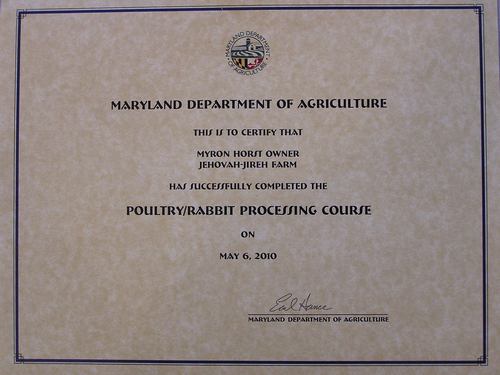
It has been discouraging the past number of years with all the reports of how the government is making things harder for small farmers and is supporting the big factory farms. We have some good news. Maryland Department of Agriculture is developing a certification and inspection program that will enable small farms to process chickens and rabbits and sell them to stores, restaurants and at farmers markets. Currently farmers are only allowed to sell chickens and turkeys to the end user at the farm under the Federal exemption. Several of us attended the processing training course on May 6. I was impressed with how they are going out of their way to make things as easy as possible for us to be certified. They are looking for ways to keep our costs as low as possible. The requirements are very reasonable and are basically what we have been doing already.

The Maryland Department of Agriculture is recognizing the demand for locally produced food and is helping you to be able to get it. A new law was also recently passed that reduces the permits and costs for farmers selling at farmers markets.

The next question is, when will we start selling chickens in the stores? We do not know. We are not sure if that is a direction that we want to go or not. We are currently selling eggs in eight stores in Maryland. To sell chickens even to one store would mean significantly increasing our production as well as processing one day a week rather than just once a month. Processing chickens is the least fun job and it is hard work. We are not sure at this point if we want to take on the additional work that would be required to sell to the stores.

What Will You Eat This Winter?

We as Americans allow others to do our food planning for us and to provide the food we need during the winter months. Is that wise? For as long as many of us can remember, one has been able to go to the grocery store every week during the winter and find it full of all kinds of fresh fruits and vegetables, and buy whatever one wanted. Being able to buy food in the grocery store all winter has been so easy and reliable that most people do not have more than a few day’s supply of food in the house. We have gone from the self sufficiency of 100 years ago to almost total dependency on the grocery store.

This winter has the potential to be different. Mexico and central California, which provide much of our winter vegetables, are experiencing the worst drought in years. The Central Valley in California is a 400-mile-long, 18 county area. More than 260,000 of the 600,000 acres that grow tomatoes, lettuce and other crops have been taken out of production this year. When you think of how many tomatoes can be grown on one acre and realize that almost half of the land is sitting idle while the rest of the land is not producing as much because of the drought, there is potential for a food shortage. A link to the Wall Street Journal’s Sept. 2 article on the drought in California  – http://online.wsj.com/article/SB125184765024077729.html?mod=rss_US_News
Note: We are not predicting that there will be a shortage of food this winter. It is possible that the food shortage will be made up from food from other parts of the world. We are just giving you a heads up.

The LA Times has a September 7, 2009 article "Mexico Water Shortage Becomes Crisis Amid Drought"

"A months-long drought has affected broad swaths of the country, from the U.S. border to the Yucatan Peninsula, leaving crop fields parched and many reservoirs low. The need for rain is so dire that water officials have been rooting openly for a hurricane or two to provide a good drenching.
"We really are in a difficult situation," said Felipe Arreguin Cortes, deputy technical director for Mexico’s National Water Commission.
"This is supposed to be Mexico’s wet season, when daily rains bathe farmland and top off rivers and reservoirs. But rainfall has been sporadic and unusually light — the result, officials say, of an El Niño effect this summer that has warmed Pacific Ocean waters and influenced distant weather patterns.
"Mexico’s hurricane season has been mild, with no major hits so far this summer, though a weak Hurricane Jimena dropped plenty of rain on parts of Baja California and the northwestern state of Sonora last week. The sparse rainfall nationwide has made 2009 the driest in 69 years of government record-keeping, Arreguin said…"
"Although no one wants to recognize it, there is a food crisis," said Cruz Lopez Aguilar…"

To read more – http://www.latimes.com/news/nationworld/world/la-fg-mexico-drought7-2009sep07,0,6988447.story

One of the best savings accounts for an uncertain future is a freezer full of food. You always have to eat. Food and water are the most basic and important necessities of life. To rely totally on others to store up and provide food for us for when we need it is putting total of faith and trust in "the system".

There is one other aspect of "What will you eat this winter?". Will your food be from local sources or will it have logged many miles over land and sea from unknown (trusted?) sources to land on your plate? There is still a little time left to get a freezer and stock up on local food for this winter. We will have eggs available all winter, but our last chicken processing will be in November. We will not have any fresh chickens available after November until May of next year. The meat chickens are too young to handle the cold outside in the winter time. The "free-range" chickens that you will see in the grocery stores this winter will not be free-range! They are conventionally raised chickens, raised in big chicken houses with a deceptive title.

Chicken Recipes

Baking whole chickens makes such an easy, carefree meal. The flavor, however, tastes like you put a lot of work into the meal. You can put your whole meal in one roaster by adding vegetables to the chicken. The vegetables then absorb the flavor of the broth and any other ingredients. If you cut up your chicken, just put the desired chicken pieces in the roaster over the vegetables. Yum!!! Are you hungry yet? 🙂

Oriental Hot and Spicy Chicken

1-4 lb. chicken
4 Tbsp. butter
3 Tbsp. toasted sesame oil
2 Tbsp. cider vinegar
3 Tbsp. soy sauce
1 tsp. hot sauce
1 Tbsp. mustard
2 garlic cloves, crushed
2 tsp. five spice powder

In a small saucepan, mix every ingredient except the chicken. Cook over medium heat until the butter is melted and the garlic is fragrant. Brush the chicken with the sauce. Bake a whole chicken in a covered roaster at 350 degrees till the chicken is tender. Plan on two hours or till the leg is loose in the joint.

Butter Chicken and Potatoes
1 whole chicken
4-6 potatoes
4 Tbsp. butter (no substitutes), melted
Salt to taste

Brush the whole chicken with butter. Sprinkle with salt. Place chicken in roaster. Pour any extra butter over the top of the chicken. Place potatoes around the chicken or under it. Cover and bake at 350 degrees 2 to 3 hours till tender.

Did you forget to put your chicken out to thaw?
Bake the frozen chicken in a 400 degree oven for 4 hours.